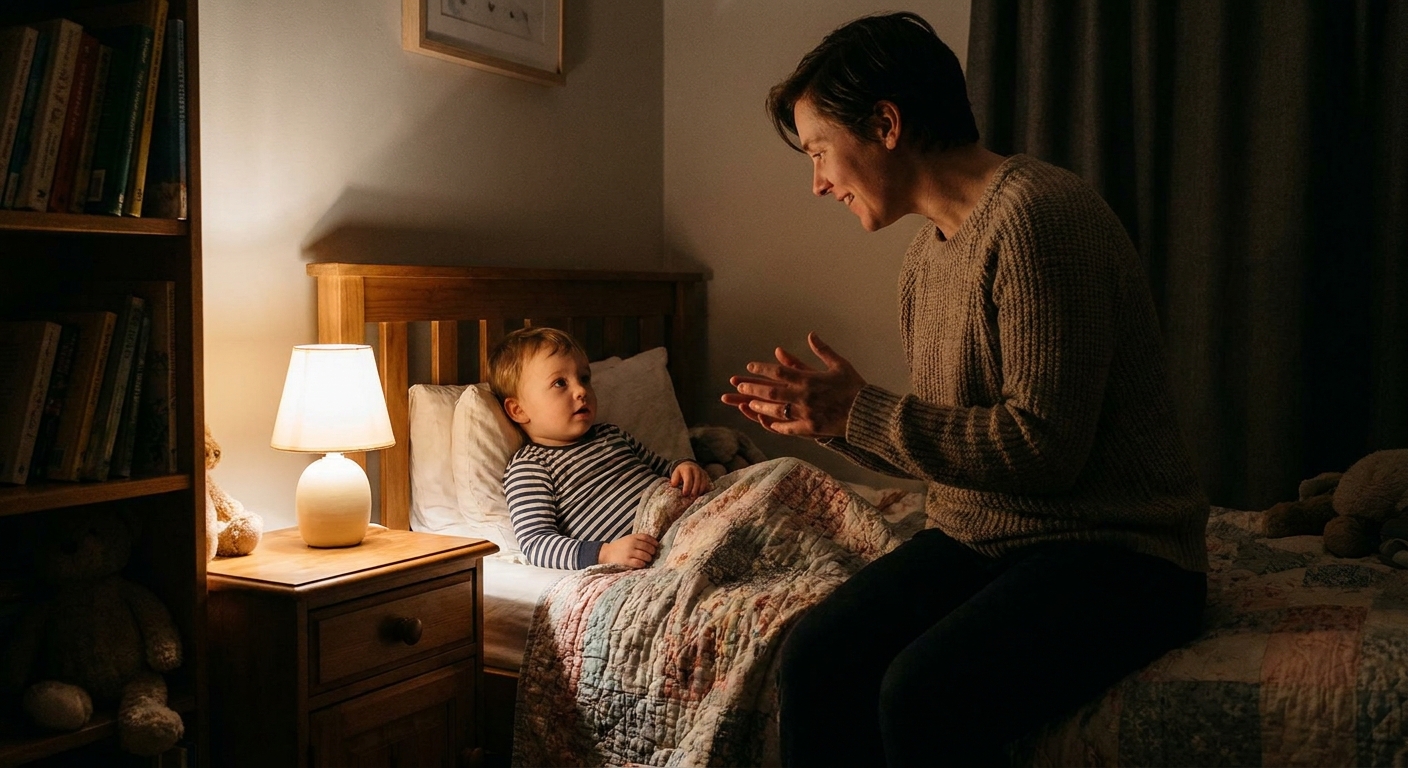

At our house, bedtime is the one time of day I try very hard not to “teach a lesson” in the loud, daytime way. But I do love sneaking in tiny moments of practice for real life dilemmas: waiting, sharing, spills, big feelings, and the classic toddler problem of “I want to do it myself, but also I want you to do it.”
The trick is to make problem-solving feel like part of the story, not a quiz. You’re handing your toddler a safe little rehearsal before sleep, with zero pressure and a cozy ending.
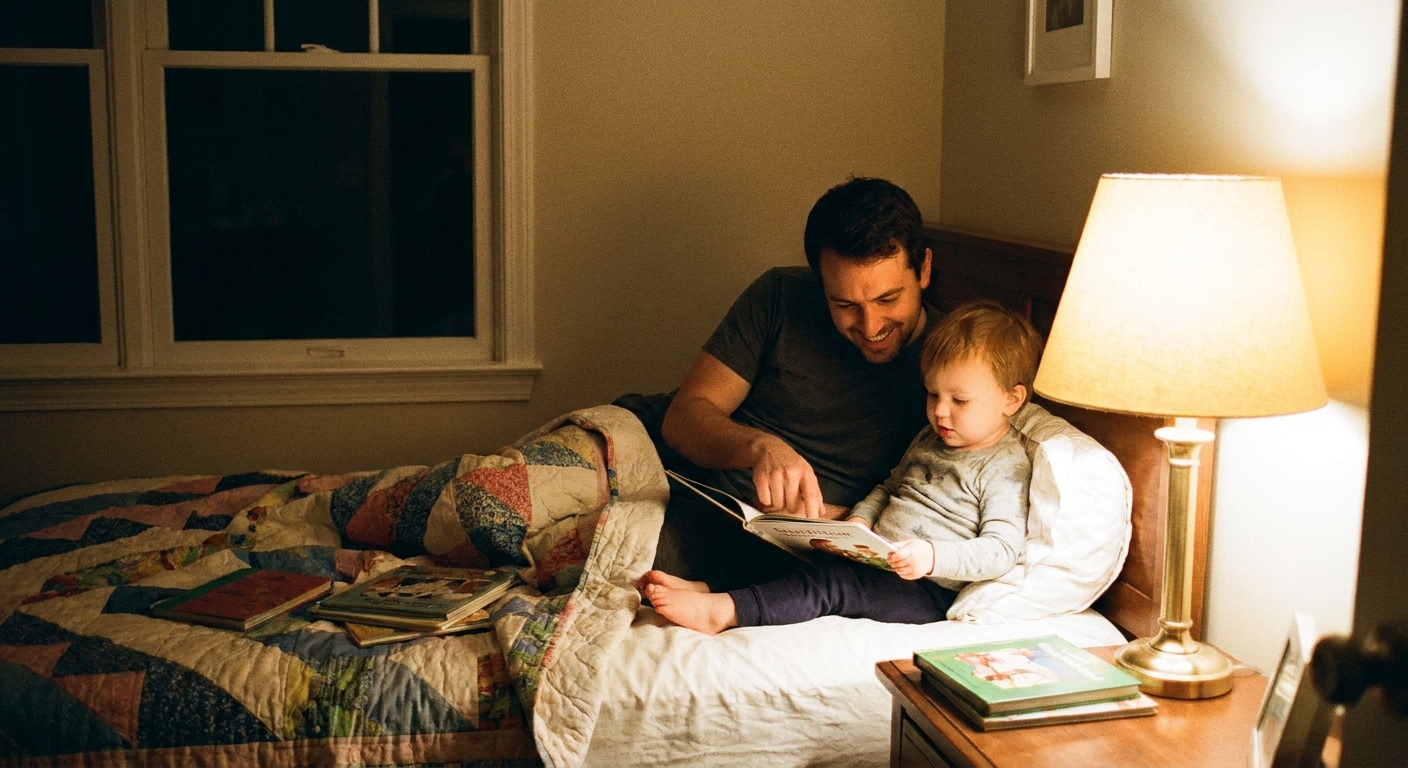
Why bedtime stories work
Many toddlers are pretty concrete thinkers, especially when they are tired. They tend to learn best when the problem is simple, familiar, and connected to how it feels in their body. A bedtime story works well because:
- The stakes are low. Nobody is actually losing the blue cup or bumping a knee.
- You can pause and practice. Toddlers can try out ideas without having to act fast.
- You can repeat the same story nightly. Repetition often helps things stick.
- You can end with calm. Every story can land softly, even if the middle includes frustration.
If you want more short, soothing story structures for the end of the day, you might also like 5-minute bedtime stories that help kids sleep.
The three-choice formula
When I am tired, I lean on one simple structure that keeps the story gentle and interactive. I call it the three-choice formula:
- Set the scene: “Bunny is getting ready for bed…”
- Introduce one small problem: “Uh-oh, Bunny cannot find the blanket.”
- Offer three choices: one silly, one so-so, one helpful.
Your toddler picks. Then you narrate what happens, and you let the story show the result. It keeps things playful, and it also teaches cause-and-effect in a way many toddlers can actually use.
Example choices
- Silly: “Should Bunny look in the toaster?”
- So-so: “Should Bunny cry really loudly until someone comes?”
- Helpful: “Should Bunny check the bed, the basket, and the couch?”
If your toddler always picks the silly option, that is fine. You can narrate it quickly, then circle back: “That did not work. Want to try a different plan?”
Techniques that build problem-solving
1) The pause-and-point
Pause right before the character decides, and let your toddler point to your hand as you count options on fingers. Toddlers often love counting on fingers. It also limits choices naturally.
2) The echo phrase
Give the character a short phrase your child can repeat when something is tricky:
- “Stop, breathe, try again.”
- “I can ask for help.”
- “First I look, then I choose.”
Use the same phrase night after night. It becomes a familiar script they can borrow in real life.
3) The tiny plan
For many toddlers, plans work best when they are short. Two steps is a sweet spot at bedtime, and if three steps feels like too much, simplify.
- “First we wipe, then we try again.”
- “First we trade, then we play.”
4) The feelings check
Many toddlers solve problems more easily when you name the feeling briefly and move on.
- “Bear feels mad. Mad feelings are big.”
- “Now Bear takes one slow breath.”
Adjust for age and temperament
This works best when it matches the kid in front of you.
- Younger 2s: Keep it extra short, use two choices instead of three, and make the “helpful” option very obvious.
- Older 3s and 4s: You can add a tiny extra step, or ask “What happens next?” and let them narrate more.
- Kids who get activated at night: Pick smaller, everyday problems (spills, waiting, sharing). If your child is currently deep in a big fear (monsters, separation anxiety, nightmares), bedtime is usually not the moment to “practice” that exact scenario. Save it for daylight.
10 gentle story prompts
These are designed for ages 2 to 4. Each prompt includes a simple dilemma plus a few solution paths you can offer as choices.
1) The Lost Lovey
Dilemma: The lovey is missing right before sleep.
- Look in three places: bed, hamper, couch.
- Ask a stuffed animal friend to “help search.”
- Make a backup plan: pick a different soft friend for tonight, keep looking tomorrow.
2) The Cup That Is Not the Right Cup
Dilemma: The character wanted the blue cup, but it is in the dishwasher.
- Choose a different cup for tonight.
- Wash the blue cup together quickly (pretend play).
- Pick two “blue” things to put nearby (a napkin, a spoon) as a compromise.
3) The Block Tower Crash
Dilemma: The tower falls and the character feels upset.
- Take one breath, then rebuild with a wider base.
- Ask for help holding the bottom blocks.
- Change the plan: build two smaller towers.
4) The Toy That Two Friends Want
Dilemma: Two animals both want the same truck.
- Trade for a different toy.
- Use a turn-taking plan. If timers rev your child up, skip it. If a timer calms your child, keep it low-key and simple.
- Play together: one pushes, one loads blocks.
5) The Zipper Problem
Dilemma: The jacket will not zip and the character gets frustrated.
- Try again slowly.
- Ask for help starting it, then finish independently.
- Pick a different jacket, and practice zipping tomorrow.
6) The Too-Loud House
Dilemma: The character cannot fall asleep because it feels noisy.
- Close the door and listen for “quiet sounds.”
- Do a simple breathing game: smell the cookie, cool the cocoa.
- Choose a comfort item: blanket, stuffed animal, nightlight.
7) The Snack Spill
Dilemma: Crackers spill everywhere.
- Get a towel, wipe, then try again.
- Use a bowl next time.
- Save what is clean, toss what is not.
8) The Waiting Problem
Dilemma: The character has to wait for a turn.
- Count to ten slowly.
- Watch and describe: “I see the swing going up and down.”
- Hold a “waiting object” like a small rock or leaf.
9) The Wrong Sock Feeling
Dilemma: Socks feel “wrong” (seams, scratchy, too tight).
- Turn socks inside out.
- Try a different pair.
- Go sockless if it is safe and appropriate (in the story, it is always fine).
10) The Big Feeling After a Hard Day
Dilemma: The character feels sad or mad but does not know why.
- Have a cuddle and name three things that went okay.
- Draw a “feeling cloud” that floats away.
- Do a repair: say sorry, get a hug, make a small plan for tomorrow.
Mini story scripts
If coming up with stories on the fly makes your brain freeze, use these as spoken scripts. Keep them short, and repeat favorites often.
Script 1: The Pajama Problem
“Tonight, Little Fox wants to put on pajamas all by themself. Little Fox tries. The shirt gets stuck. Little Fox feels mad.”
“Should Little Fox: (1) throw the pajamas across the room, (2) say ‘Help me!’ very loudly, or (3) sit down, take a breath, and ask for help with the head hole?”
“Little Fox chooses (your toddler picks). The grown-up fox helps just a little bit. Little Fox pulls the shirt down and says, ‘I did it!’”
“Then Little Fox snuggles into bed. The bed feels warm. Little Fox’s eyes get heavy. Goodnight, Little Fox.”
Script 2: The Toothbrush Trouble
“Bunny is brushing teeth. Bunny wants to do it fast. Oops. The toothpaste falls in the sink.”
“Should Bunny: (1) brush with a carrot, (2) cry and quit, or (3) rinse, put a tiny new dot of toothpaste, and try again?”
“Bunny picks (your toddler picks). Bunny rinses, tries again, and feels proud.”
“Bunny spits, takes a sip of water, and climbs into bed. Bunny’s mouth feels fresh. Bunny smiles and gets sleepy.”
Script 3: The Nighttime Noise Mystery
“Bear is in bed and hears a sound: creak… creak… Bear’s heart goes thump-thump.”
“Should Bear: (1) hide under every blanket forever, (2) yell, or (3) listen closely and do a quiet investigation?”
“Bear chooses to listen. Bear hears a soft jingle. It is the dog scratching and turning around. Bear says, ‘Oh. Just dog sounds.’ Bear takes one slow breath and snuggles in.”
“The room feels safe. Bear’s eyes close. Goodnight, Bear.”
Keep it calming
- Pick problems that are familiar but small. Save big fears and major conflicts for daytime.
- Limit choices to two or three. More options can energize some toddlers instead of settling them.
- Lower your voice for the solution part. I get slower and softer right when the character makes a plan.
- Always end with the same landing. Warm bed, safe body, heavy eyes, goodnight.
- Skip consequences that feel scary. Toddlers do not need “and then nobody helped” at 8:14 pm.
If you want another easy, repeatable format that toddlers can steer, try the add-a-sentence story. It works at bedtime too, especially when you keep sentences short.
If your toddler gets silly or upset
If they get silly
Let the silly choice happen quickly, then reset: “That was funny. It did not solve it. Want to try a different plan?”
If they insist on an unhelpful choice
Give it a gentle result. No lectures. Just a quick “did not work,” and offer a new try.
“Bunny stomped and stomped. The blanket still did not appear. Bunny paused. Bunny tried a new idea.”
If they get upset
Drop the problem-solving and switch to comfort. You can say, “Let’s make the story extra cozy now.” Then move straight to the calm ending. The goal at bedtime is safety, not skill-building.
For more calming story ideas on anxious nights, When I was little stories can be surprisingly grounding.
A quick bedtime routine
This is my simplest setup for problem-solving stories, especially on nights when everyone is running on fumes:
- Two-minute settle: lights low, one sip of water, one cuddle.
- One story with one problem: just a single dilemma and a simple plan.
- Same closing line every night: “You are safe, you are loved, your body can rest.”
Some families also like doing one tiny “reset” before story time. If that helps your house, keep it playful and short like the 10-minute family tidy-up game earlier in the evening, then transition into books and bed.
More story fuel
If you are in the phase where you have told every story you have ever heard in your life, you are not alone. A few Smart Central favorites to keep in your back pocket:
- 50 quick story starters for parents who have run out of ideas
- Household objects as story characters (this one is perfect for toddlers)
- Kids story podcasts for a 10-minute dinner window for earlier in the day, when you need your hands free
My biggest reminder, from one tired parent to another: if you tell the same simple story for two weeks because it works, that is not “boring.” That is toddler magic. Repetition is often how the problem-solving script sinks in, and it is also how bedtime starts feeling predictable and safe.