

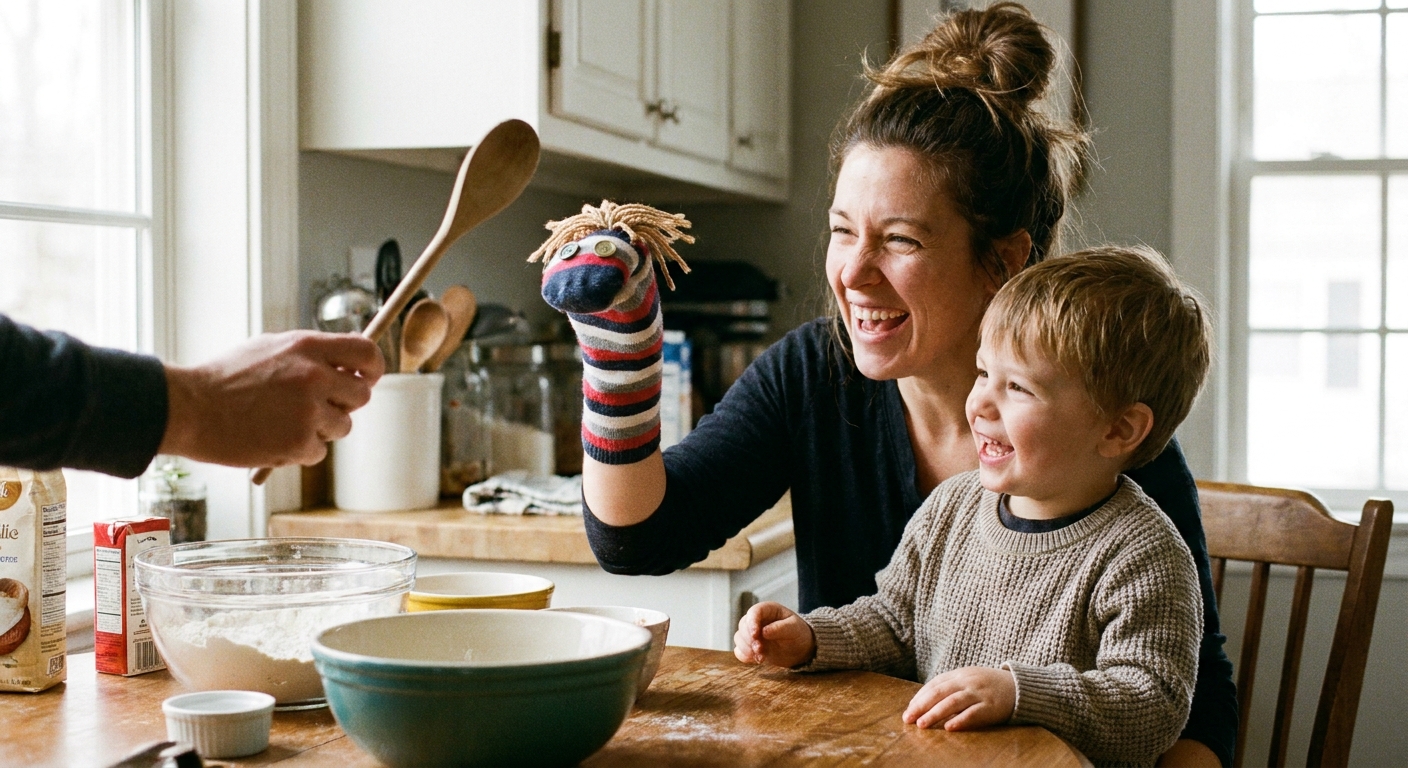
One of my favorite parenting “saves” happens in the least glamorous moments: I am elbow-deep in dinner prep, the dog is doing zoomies, and someone is melting down because their sibling looked at them “wrong.” That is when I grab whatever is closest, usually a sock or a wooden spoon, and announce (in a very serious voice), “Hello. I am Captain Spatula. I have an important mission.”
It is not about being theatrical. It is about being fast. Everyday household objects can make great spontaneous story characters because they are already in your hands and kids instantly accept the premise, as long as you pick something age-appropriate and you are nearby.
The 30-second setup
If you have 30 seconds, you can turn any object into a character kids will follow. Here is my quick formula:
- Name: Keep it simple and a little silly (Captain Spatula, Sir Sockington, Detective Dishcloth).
- One job: “I clean up messes,” “I guard the snack drawer,” “I find missing things.”
- One feeling: Excited, worried, grumpy, shy. Feelings make kids lean in.
- One problem: “I lost my hat,” “I need help building a fort,” “I cannot find the magic crumb.”
The magic is that you are not asking your child to “calm down.” You are giving them a role.
Objects that work fast
You can use almost anything, but these are the ones that show up in real houses on real days, especially when you are short on time.
Wooden spoons and spatulas
- Character vibe: Brave captain, wise grandma, strict coach.
- Quick add-on: A dish towel cape or a washable silicone band for “hair.”
- Mini plot: “The spoon is training for the Great Stir-Off, but needs a cheering squad.”
Socks (clean or mismatched)
- Character vibe: Goofy sidekick, dramatic singer, curious explorer.
- Quick add-on: Your fingers can be eyes, eyebrows, and a talking mouth. (If you use stick-on eyes, save them for older kids who do not put things in their mouths.)
- Mini plot: “This sock is searching for its missing pair in the Land of Laundry.”
Paper cups
- Character vibe: Shy robot, baby penguin, space ranger.
- Quick add-on: Turn it upside down and tap the top like it is “thinking.”
- Mini plot: “Cup-bot can only speak in questions. Everyone must answer to unlock the next step.”
Dishcloths and potholders
- Character vibe: Blanket dragon, tiny ghost, royal cape.
- Quick add-on: Fold a corner into a “snout,” or pinch the fabric to make a “mouth.”
- Mini plot: “The dishcloth dragon only stops stomping when it gets three kind words.”
Stuffed animals or toy figures
- Character vibe: The shy helper, the brave leader, the worried baby.
- Quick add-on: A sticker “badge” on the belly for a detective or a nurse.
- Mini plot: “Detective Bear is hunting the Case of the Disappearing Snack.”
Measuring cups and spoons
- Character vibe: A family of bears, pirates, construction crew.
- Quick add-on: Stack them like helmets.
- Mini plot: “The measuring cups are building a bridge to Snack Island.”
Quick safety and age notes
I try to keep this kind of play easy on my future self. A simple rule that helps: the younger the kid, the bigger and softer the prop.
- Under 3: Skip small add-ons like buttons, beads, clothespins, and hair ties. Stick to big socks, dishcloths, stuffed animals, and cups, and stay within arm’s reach.
- Preschoolers: You can add simple “costumes” (a towel cape, a sticker badge) but I still avoid anything tiny that can pop off.
- Early elementary: They can handle more complex plots and building sets, and they usually love being the director.
One more thing: I do not use toothbrushes as characters. Even a rinsed brush is an oral-care tool, and I prefer keeping those separate from play.
Puppet show, seated
This is my favorite part: you can run a whole “show” from the couch, the kitchen stool, or the edge of the bathtub while someone splashes.
Pick a stage
- Behind the couch: You hide the puppets low, pop them up for dramatic entrances.
- Doorway: The doorframe is the “castle gate.”
- Kitchen counter edge: Characters can “peek” over while you keep chopping.
- Laundry basket: Instant ship, cave, or dragon nest.
Use three voices
You do not need a different voice for every character. Three is plenty:
- Normal voice: Narrator
- High voice: Worried or excited character
- Low voice: Bossy or sleepy character
If you hate doing voices, you can skip them. A whisper, a serious “robot voice,” or just talking normally still works.
Keep the plot tiny
A great emergency story has just three beats:
- Uh-oh: Something went wrong.
- Try: The character tries two silly solutions.
- Win: The child solves it or gets to choose the ending.
Four story buttons
When you need an immediate distraction, these themes hook kids fast because they invite participation.
- The Mission: “We need to rescue the missing teddy from under the table.”
- The Mystery: “Who took the last cracker?”
- The Challenge: “Can you do three quiet ninja steps to sneak past the dragon?”
- The Helping Plan: “My character feels frustrated. What should we do first?”
If you have a kid who resists pretend play, offer a simple choice instead of a big invitation: “Do you want a mission, a mystery, or a challenge?” Even reluctant kids tend to pick one.
If you want more ready-to-go prompts for those blank-brain days, I keep this page bookmarked: 50 Quick Story Starters for Parents Who Have Run Out of Ideas.
Chores as story scenes
I am not going to tell you to “make everything fun.” Some days are just work. But I have found that a character can make a chore feel less bossy and more doable.
Try these swaps
- Cleanup: A dishcloth becomes “The Crumb Eater,” hunting crumbs one by one.
- Getting dressed: A sock is “The Lost Twin,” begging to find its match.
- Hand washing: A cup is “Bubble Boss,” counting the foam seconds.
- Putting toys away: A spoon is “Captain Sort,” assigning toys to their “homes.”
For toddler-friendly micro stories that pair with everyday routines, Micro Stories for Toddler Chores has more of that short-and-sweet style.
Simple guardrails
Spontaneous characters work best when you keep it simple and safe. A few guardrails I use in my own house:
- Avoid breakables: No glass, no sharp utensils, no heavy décor.
- Watch the “tiny stuff”: If it can fit in a child’s mouth, it is not an add-on for little kids.
- Keep kitchen props clean: If it touches raw food, it does not become a puppet until it is washed.
- Set an ending: “Two minutes, then the characters go to sleep.” Kids handle transitions better when the character announces it.
- Let kids direct: If they grab the spoon and change the story, that is a win, not a derail.
Quick scripts
These are short on purpose. You can say them exactly as written and then let your child take over.
1) The Sock Who Lost Its Laugh
“Hi. I am Sir Sockington. I cannot find my laugh. Can you help me try three silly laughs?”
2) The Wooden Spoon’s Brave Job
“I am Captain Spatula. I have to stir the soup, but I am a little nervous. Will you be my cheering crew and count to ten with me?”
3) The Cup Who Only Asks Questions
“Beep. I am Cup-bot. I can only ask questions. What is your favorite animal? What sound does it make? Where does it live?”
4) The Dishcloth Dragon Who Needs Kind Words
“Roar. I am the Dishcloth Dragon. I am stomping because I feel grumpy. Can you tell me three kind words so I can calm down?”
Make it a habit
Once your kids love this, it is easy to keep a tiny “story basket” in one spot. Mine is a small bin in the hall closet. Nothing fancy:
- 2 clean socks (mismatched on purpose)
- 1 wooden spoon
- 1 paper cup stack
- 2 dishcloths
- A few safe add-ons like washi tape or stickers (stored out of reach of toddlers)
And if you are building a bigger rotation of story activities, you can browse our full Kids Stories hub here: Kids Stories. I like having a menu for those long afternoons when everyone is tired and nobody can decide what to do.