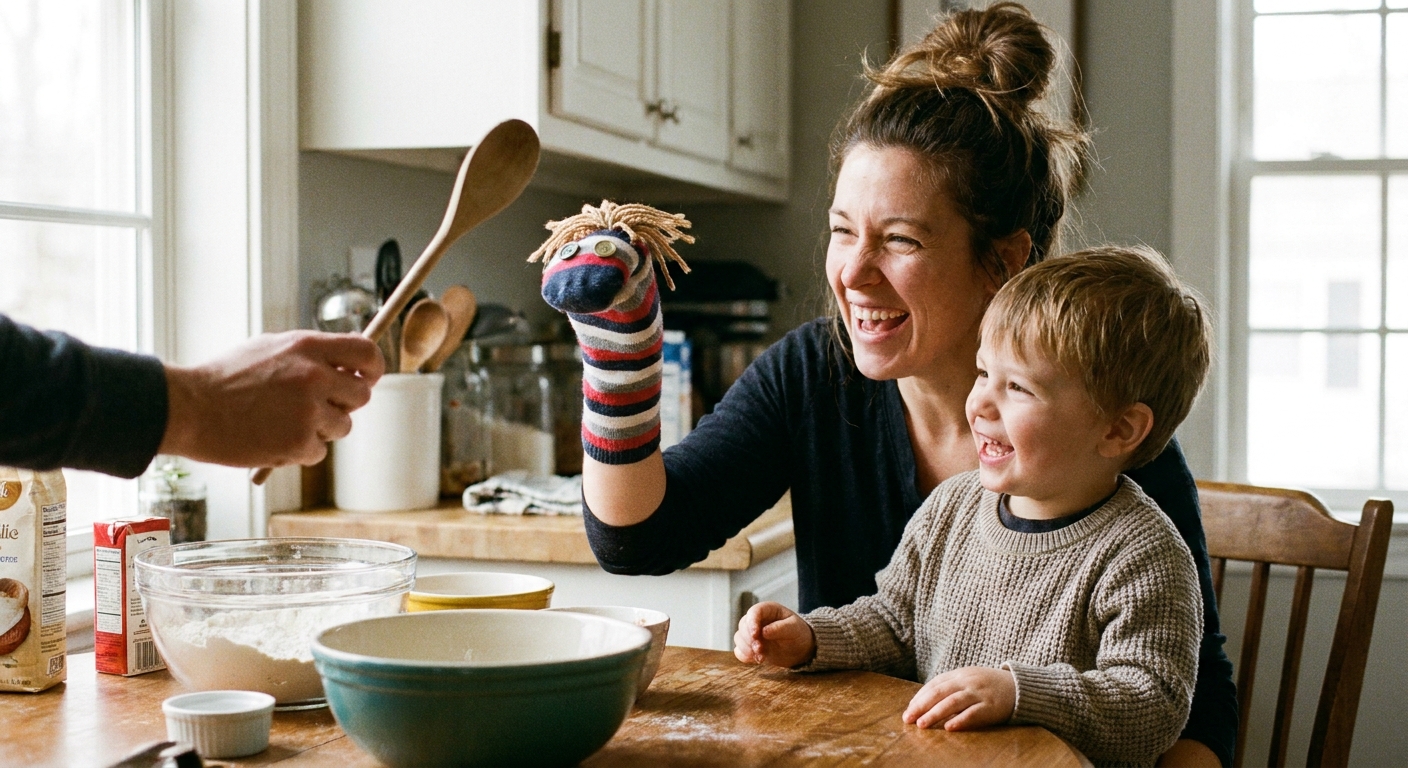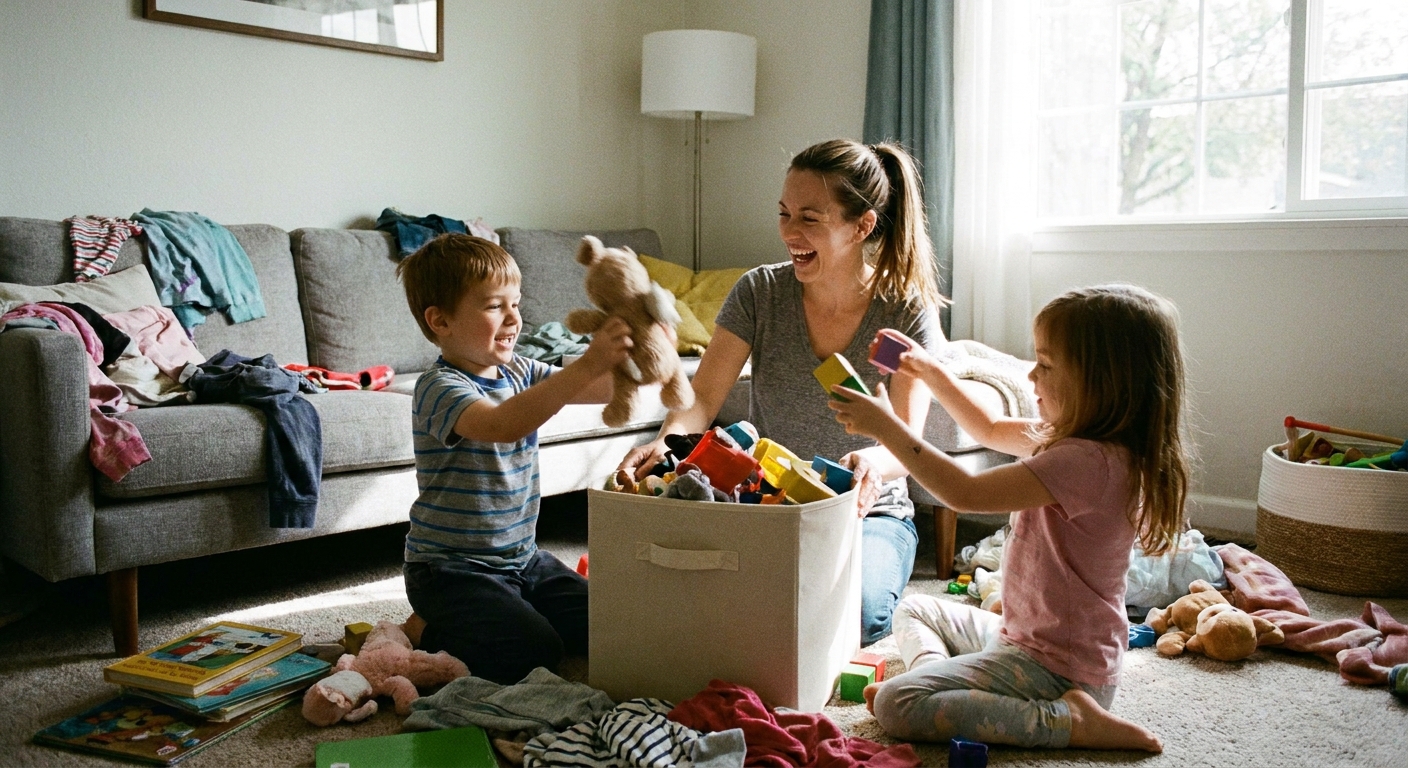

On the days my house feels like a toy store exploded, I have two choices: repeat myself until I am hoarse, or turn cleanup into a tiny story my toddler can “star” in. I pick the story.
I call them micro-stories: quick, imaginative scenarios that last one to three minutes and give your child a role, a mission, and a finish line. No crafts, no prep, no “perform for Mom.” Just a playful prompt that helps their brain switch from wandering to doing.
What a micro-story is (and why it can help)
A micro-story is a short pretend setup that makes a normal task feel like purposeful play. Many toddlers love:
- Roles (helper, driver, animal rescuer)
- Clear missions (three toys, five socks, all the books)
- Movement (carry, park, deliver)
- Immediate payoff (we finish the job fast)
It often helps because it gives your child a simple structure: Who am I? What is my job? When are we done? For a lot of toddlers, that is basically motivation in three questions.
The 30-second setup
If you only remember one thing, remember this:
- Role: “You are the…”
- Mission: “Your job is…”
- Finish line: “When we do ___, we’re done.”
Example
Role: “You are the train conductor.”
Mission: “We have to pick up all the stuffed animals and get them to the station.”
Finish line: “When the basket is full, the train can rest.”
Notice what is missing: long explanations, questions they can say no to, and pressure for perfection. (A choice between two acceptable roles is different. It keeps you in charge of the task while still giving them some control.)
Scripts to use today
Steal these exactly as written, or swap in your child’s current obsession (dinosaurs, trucks, kitties, astronauts).
Toy pickup
- “Parking Garage”: “All the cars need to park for the night. Park them gently in the bin. When the floor is clear, the garage door closes.”
- “Animal Rescue”: “The animals are stuck in a messy jungle. Carry them one by one to the safe cave (basket). When the last animal is safe, we cheer.”
- “Museum Curator”: “We are opening the museum tomorrow. Put the blocks on the shelf like a real exhibit. When the shelf is full, the museum is ready.”
Books
- “Library Return”: “These books are due today. We have to return them to the library shelf or basket. When all the books are back, return complete.” (For older kids: “Covers facing out.”)
- “Sleepy Stories”: “The books are yawning. Tuck them into bed (book basket). When they are tucked in, they can rest.”
Laundry and clothes
- “Sock Match Detectives”: “We are detectives finding sock twins. Put twins together. When we find three pairs, case closed.”
- “Clothes Hotel”: “Shirts check in here, pants check in there. Your job is to deliver guests to the right room. When the basket is empty, hotel is full.”
Kitchen reset
- “Robot Helper”: “Beep beep. Robot helper collects cups and brings them to the sink. When the counter is clear, robot powers down.”
- “Potion Lab”: “We have to clear the table for the potion lab. Plates go to the sink, crumbs go to the trash. When the table is empty, lab opens.”
Bathroom routines
- “Toothbrush Car Wash”: “Your teeth are cars covered in mud. Brush top cars, brush bottom cars. When we rinse, the cars are shiny.”
- “Bubble Patrol”: “Hands have invisible paint. Scrub with soap until the paint disappears. When we rinse, mission complete.”
Quick safety note: In kitchens and bathrooms, I keep micro-stories focused on safe items only. I stay right there, and I keep kids away from hot surfaces, sharp tools, cleaners, choking hazards, and deep water.
6 tips that make it easier
1) Keep it tiny
If it takes longer to explain than to do, it is too big. Aim for one sentence per step.
2) Use a real object as the prop
The basket is the “cave.” The hamper is the “hotel.” The bin is the “garage.” Real props keep the pretend grounded so toddlers can actually follow through.
3) Give a number they can win
Instead of “clean up everything,” try “Let’s rescue five animals.” You can always start a second round if they are into it.
4) Narrate like a sportscaster (briefly)
“You found a sock twin. Straight to the basket.” Short narration keeps momentum without turning into a lecture.
5) End the story on purpose
Many toddlers do better when the game clearly ends. Try: “Mission complete. High five. Now we rest.” Then stop talking.
6) Repeat favorites
Adults get bored. A lot of toddlers feel safer with repetition. If “Parking Garage” works, use it three nights in a row.
Common speed bumps
“My toddler says no.”
Give two acceptable roles and keep your tone matter-of-fact: “Do you want to be the conductor or the cargo loader?” If they still refuse, start without them: “Okay, I’m starting the rescue. This turtle needs help.” Many toddlers join once play is already happening.
“They make a bigger mess.”
Choose stories that require putting items into a container, not throwing them across the room. Use words like “carry,” “deliver,” “tuck,” “park,” and “place.” Save “toss” for soft items only, and keep the target close.
“They melt down halfway through.”
That often means the task is too long, they are hungry, or they are tired. Shrink the finish line: “Just three more toys, then we are done.” Ending early is not failing. It is smart pacing.
“They want me to do it.”
Be their sidekick, not the hero. “You’re the captain. I’m your helper.” If your child is not doing any yet, start 1:1 for a minute, then shift to one item for every five they do, then fade yourself out.
“My kid is not into pretend play.”
Totally fine. Some kids prefer a “real job” over a character. Use the same structure with plain language: “Your job is delivery helper. Put five toys in the bin. When five are in, we are done.” No voices required.
A 5-minute routine
This is my go-to when I need quick wins before dinner or bedtime.
- Pick one zone. (Just the rug. Just the table. Just the bathtub toys.)
- Choose one container. (Basket, bin, hamper.)
- Tell the micro-story. Role, mission, finish line.
- Do one round. Usually 10 to 20 items, or 2 minutes max.
- Close the story. “Mission complete,” then transition to the next routine.
If you want to layer in more story play outside chore time, we also have a fun, low-prep storytelling activity you can do with kids of different ages: Make a Story Path With Paper Cards.
By age: small tweaks
Ages 2 to 3
- Keep it physical and simple: deliver, park, rescue, feed.
- Use very short finish lines: 3 to 5 items.
- Expect lots of re-doing. That is normal learning.
Ages 3 to 4
- Add tiny challenges: colors, categories, “find all the blue blocks.”
- Let them invent the role. You supply the finish line.
- Try two-step stories: pick up toys, then “wash hands for the feast.”
Mixed ages
- Give the toddler the “deliver” job and the older kid the “sort” job.
- Keep the toddler’s portion winnable so they do not get overshadowed.
Micro-stories for routines
- Getting dressed: “We are suiting up for the snow expedition. Socks are warm boots. Shirt is the explorer jacket. When the zipper is up, we are ready.”
- Leaving the house: “We are astronauts doing a gear check. Shoes, jacket, water bottle. When all gear is on, we launch.”
- Car seat: “Buckle is the safety shield. When it clicks, the shield is powered.”
When you do this consistently, many toddlers start to expect that routines have a playful script. You are often not bribing them into cooperation. You are giving them a path they can actually follow.
If you want more ideas that fit real family schedules, you can browse our kids content hub here: Kids Stories.