

When my kids were toddlers, I wanted two things at the same time: a sweet little creativity window for them, and a kitchen floor that did not look like it hosted a glitter convention. The trick that finally worked in our house was a tiny, repeatable setup that takes about five minutes, limits the mess by design, and is easy enough that a toddler can “run” it with minimal help.
This is the exact approach I recommend when you want your child to craft more independently while you fold laundry, unload the dishwasher, or answer one email without someone coloring the dog.
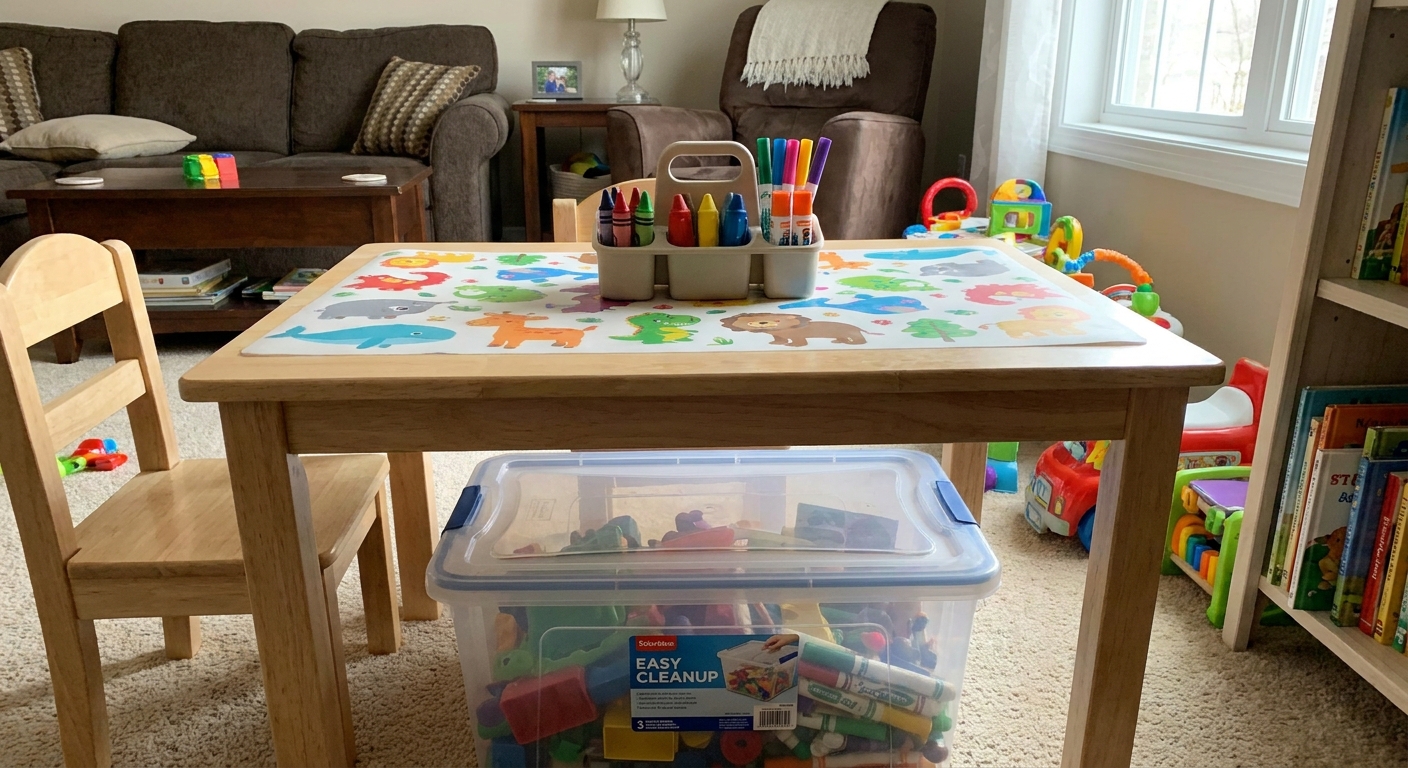
The five-minute setup
If you do nothing else, do these five steps. It is the fastest route to more independent crafting without constant hovering.
- Choose one spot that is easy to wipe (kitchen floor, tile, or a washable rug).
- Put down one “always” protector (silicone mat, vinyl tablecloth, or a flattened cardboard box you keep nearby).
- Set out one container of supplies (a handled caddy or shoebox bin) with only five to seven items inside.
- Offer one project prompt (stickers on paper, glue and tissue squares, dot markers on circles you drew).
- Place one cleanup bin right next to them (an empty lidded tub or small laundry basket).
This works because, in my experience, many toddlers do better with limits. Fewer choices often means more doing, and less dumping.
Pick the right location
Independence depends on you being able to say, “I can see you, keep creating,” and continue your task. Here is what to look for:
- Within your sight line from where you will be working (kitchen counter, laundry room doorway, dining table).
- A wipeable surface underneath or nearby. If you have carpet, that is fine, just add a bigger barrier.
- No access to your “no” zones like the paper shredder, pet water bowl, or a shelf of keepsakes.
- Comfortable posture for your child. If a chair is too high, a lot of toddlers start climbing, leaning, and wobbling more than you want.
In our house, the winning spot was the end of the kitchen near the pantry. I could cook, wipe counters, and keep an eye on tiny hands.
Quick stage note: if your child is in a big climbing or mouthing phase, floor crafting can actually be easier than a chair. A mat on the floor plus a low bin of supplies keeps things steadier.
Your low-mess supply list
“Mess-free” is really “low-mess plus predictable cleanup.” These are toddler-friendly options that give a big creative payoff with minimal risk.
Low-mess supplies for ages 1 to 3
- Chunky crayons (harder to snap, easier to grip).
- Washable dot markers (more contained than open markers, but still a boundary item for walls and clothes).
- Stickers (large-format stickers are easiest to handle and easier to spot during cleanup).
- Glue sticks (skip liquid glue for independent time).
- Pre-torn paper squares or strips (construction paper, tissue paper).
- Coloring pages or plain paper (cardstock holds up best).
- Washi tape (tears by hand, usually less residue than many plastic tapes).
What I keep out of reach
- Loose glitter, confetti, sequins, tiny beads
- Paint (unless I am supervising, and even then I prefer watercolor style sets or water-painting books/mats that limit spills)
- Scissors (even “toddler scissors” are a supervision item in my book)
- Markers without a clear “washable” label
Yes, your toddler will eventually be ready for the fun stuff. But if your goal is a five-minute setup and a station they can use while you do chores, start here and stay here longer than you think you should.
Age and stage adjustment: for young toddlers (around 12 to 24 months) or heavy mouthers, I keep it extra simple: crayons and paper, maybe tape with close supervision. For older toddlers (2 to 3), stickers and dot markers can work well, as long as they are still within sight and you keep the rules consistent.
Storage that helps independence
The secret is not a giant craft cart. It is a small kit with a hard limit.
A simple storage system
- One handled caddy for daily supplies (what you are okay with them accessing).
- One lidded bin for overflow (stored up high, rotated by you).
- One paper tray (a magazine file, shallow box, or a stack of cardstock clipped together).
If your toddler can carry it with two hands, it is the right size. If they need to drag it, it is probably too big and it will be dumped.
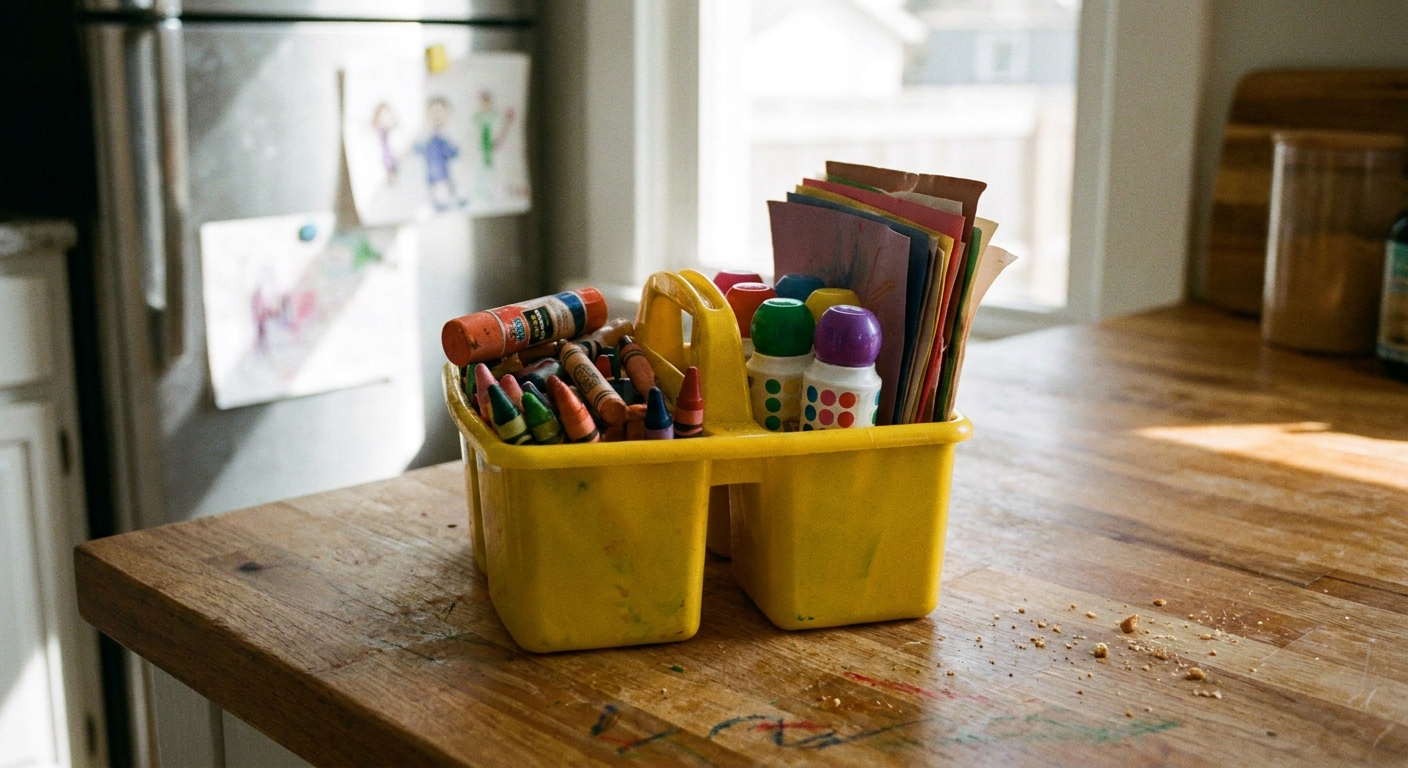
My seven-item rule
I aim for five to seven total items inside the caddy. Here is an example that covers most days:
- 1 pack chunky crayons
- 2 dot markers
- 1 glue stick
- 1 sheet of large stickers
- 10 sheets of cardstock
- 1 small stack of pre-torn tissue squares
- 1 roll washi tape
Everything else stays in the lidded bin for you to swap in later. This keeps the station fresh without increasing mess.
The always-ready surface
This is where a lot of parents accidentally create more work. If you have to hunt for a towel and clear the table every time, it often will not happen on a busy day.
Pick one protector
- Silicone mat: wipes clean in seconds and stays put.
- Vinyl tablecloth: cheap, big coverage, folds away.
- Flattened cardboard box: free, surprisingly effective, and easy to replace.
I keep our mat rolled behind a bookshelf. It is not pretty storage, but it is realistic, and that is the whole point.
Boundaries without hovering
Toddlers can handle independence when the rules are simple and repeatable. Before you step away, say the same short script every time. In our house it sounds like this:
- “Supplies stay on the mat.”
- “Paper stays on the mat.”
- “When you are done, everything goes in the bin.”
Then I give one doable choice: “Do you want stickers or dot markers first?” That is enough autonomy without opening the door to “I want paint and also scissors and also the wall.”
Three low-mess crafts
These are my go-to prompts when I need a reliable 10 to 20 minute stretch.
1) Sticker collage
- Give one sheet of large stickers and one piece of cardstock.
- Draw three to five big circles or squares on the page.
- Prompt: “Fill the shapes with stickers.”
2) Tissue paper stained glass
- Hand them a glue stick, tissue squares, and cardstock.
- Prompt: “Glue the squares anywhere you want.”
- Optional: Give only two colors to keep it calmer.
3) Dot marker targets
- On a page, draw large dots, simple smiley faces, or a path of circles.
- Prompt: “Dot on the circles.”
If you want more simple craft ideas you can set up quickly, our Kids Crafts guide collects easy, realistic activities that fit into regular days.
Cleanup in one minute
Cleanup is where the station either becomes a habit or dies. Here is the routine that kept it doable for me when I was tired.
The one-bin reset
- All supplies into the caddy (you do not need perfect organization).
- All scraps into the cleanup bin (or straight into the trash).
- Wipe the mat with one wet wipe or a damp cloth.
- Caddy goes “home” on a low shelf or pantry floor.
Important: toddlers love a job. I ask mine to carry the scraps bin or stack the paper. It is not faster in the moment, but it builds the habit that crafting includes cleanup.
Troubleshooting
“My toddler dumps the caddy every time.”
Reduce the contents to three items for a week. Seriously. Start with crayons, paper, and a small sticker sheet only if it is age-appropriate for your child. Add one item back at a time once dumping stops being the main activity.
“They want to craft, but only for two minutes.”
That is normal. Rotate the prompt, not the whole setup. Same supplies, new challenge: “Can you make a sticker road?” or “Can you fill all the circles?”
“They keep coloring off the paper.”
Swap to a bigger paper size and a stronger boundary: “Crayons only touch paper.” If it continues, use a cardboard box as the base and tape the paper down with washi tape.
“My child still mouths everything.”
If your toddler is in a heavy mouthing stage, keep this as a supervised station only and skip small items (including many stickers). For a calmer, contained option when you need your hands for chores, you might like our story-based ideas for busy moments, like micro stories for toddler chores, which can buy you a few minutes without little pieces.
A realistic safety note
I am a big fan of independent play, but I am an even bigger fan of safety. Toddlers should still be within sight and checked on frequently, especially with any small items that could be mouthed. Choose supplies that match your child’s stage, and when in doubt, simplify.
The goal
The best toddler craft station is not the cutest one on the internet. It is the one you can set up fast, clean up fast, and repeat three times a week without resentment. Start small, keep it boring, and let the routine do the heavy lifting.
And if you are in the season of needing lots of quick, calm activities, our Family Activities guide is a good next stop for ideas that fit into real life.