

If I had a dollar for every time I started making dinner and heard, “I’m boooooored,” I could probably pay someone to chop onions for me. My favorite solution is what I call kitchen counter science: quick experiments that feel like magic, use pantry basics, and buy you a solid 10 minutes to stir the pasta without negotiating screen time.
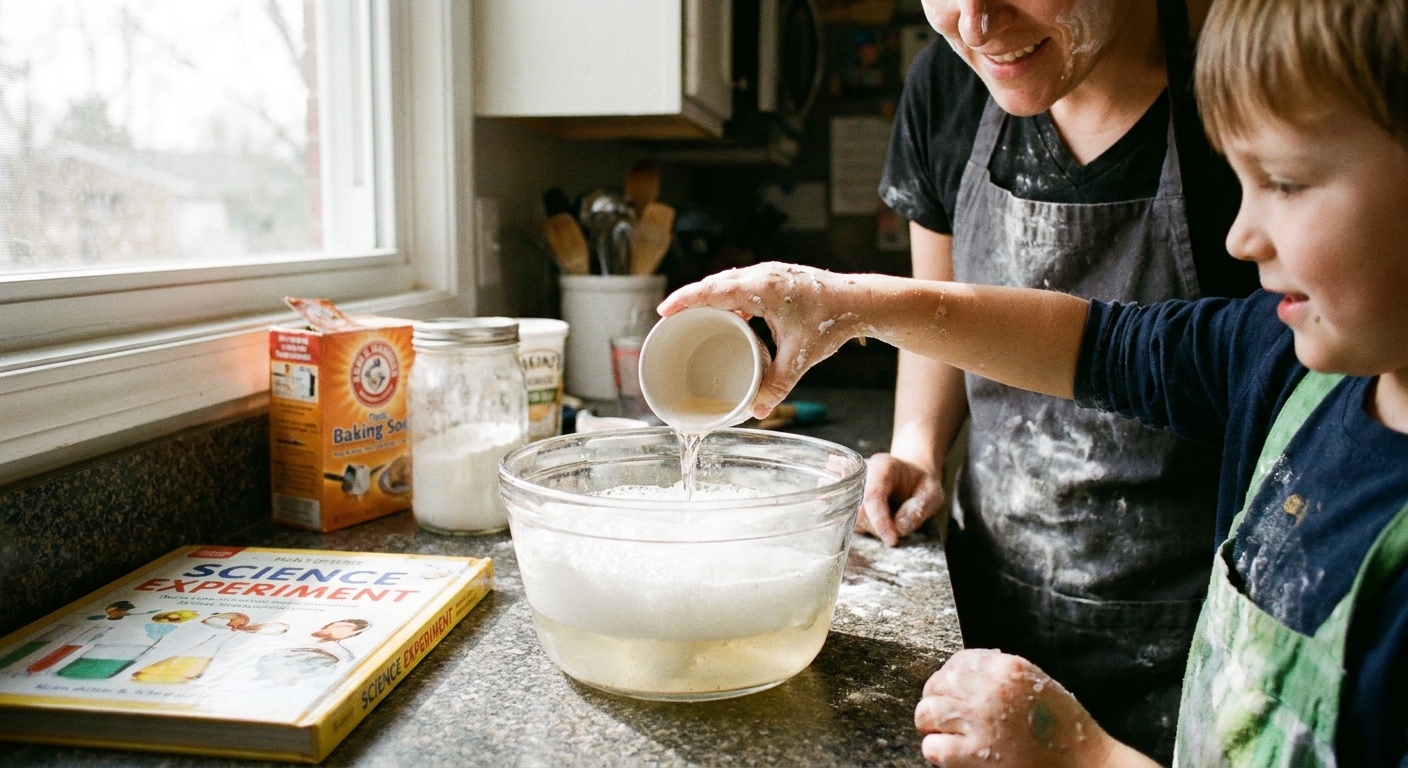
All five experiments below use the same star duo: baking soda (a base) and vinegar (an acid). When they mix, they create carbon dioxide gas, which shows up as bubbles, foam, and sometimes balloon inflation. The reaction also makes water and a dissolved salt (sodium acetate), so nothing “vanishes”, it just changes form. You supply the setup. Kids supply the “WHOA!”
Quick setup
Before you start, take 60 seconds to set yourself up for calm cleanup. This is the difference between “fun science break” and “why is there purple foam on my baseboards.”
- Choose a zone: empty sink, a rimmed baking sheet on the counter, or a big mixing bowl.
- Grab a towel: one damp cloth for quick swipes, one dry towel for hands.
- Safety basics: keep vinegar away from eyes, don’t taste anything, and supervise anything involving small cups.
- Balloon note: skip balloon experiments with kids under 3, and keep uninflated balloons out of reach. They are a choking hazard.
If your kids love quick experiments like this, you might also like our bigger list of ideas in Family Activities.
1) Balloon inflator
This one is a classic because it looks impossible until it works.
What you need
- 1 empty plastic water bottle
- Vinegar
- Baking soda
- 1 balloon
- Optional: funnel or a rolled paper cone
Steps
- Pour 1/4 cup vinegar into the bottle.
- Stretch the balloon a few times (this helps it inflate more easily).
- Add 1 to 2 tablespoons baking soda into the balloon using a funnel or paper cone.
- Carefully fit the balloon opening over the bottle mouth, keeping the baking soda up in the balloon.
- When ready, lift the balloon so the baking soda falls into the vinegar. Watch the balloon inflate.
What to say
“The bubbles are a gas called carbon dioxide. The gas needs space, so it fills the balloon.”
Fast cleanup
Dump the liquid down the sink and rinse the bottle. The balloon can be reused if it stays dry inside.
2) Colorful fizz cups
If you only have time for one experiment while you sauté something, pick this. It is fast, bright, and repeatable. (These do not change color on their own, they are just colorful and fizzy.)
What you need
- 3 to 6 small clear cups
- Water
- Baking soda
- Vinegar
- Food coloring
Steps
- Add 2 tablespoons water to each cup.
- Stir 1/2 teaspoon baking soda into each cup.
- Add 1 to 2 drops of food coloring to each cup (different colors make it feel like a “lab”).
- Pour a little vinegar into a small cup. Give kids a measuring spoon and let them add 1 teaspoon vinegar at a time to any cup they choose.
- Challenge: “Can you make the biggest fizz without overflowing?”
Make it more science
- Ask them to predict: “Which cup will fizz the most?”
- Try the same amount of vinegar in each cup and compare.
Fast cleanup
Pour into the sink and rinse the cups. Wipe any splashes right away if you used bright food coloring.
3) Mini volcano tray
This is the volcano kids want, without building a mountain out of salt dough.
What you need
- Rimmed baking sheet or roasting pan
- 3 to 6 small cups (or a muffin tin)
- Baking soda
- Vinegar
- Dish soap
- Food coloring (optional)
Steps
- Set cups on the tray (this is key for easy containment).
- Add 1 tablespoon baking soda to each cup.
- Add 1 small squirt of dish soap to each cup (this makes the foam thicker and slower, which kids love).
- Optional: add 1 drop food coloring.
- Pour 2 tablespoons vinegar into each cup and watch the foam rise.
- Want a second eruption? Add a little more vinegar 1 teaspoon at a time.
What to say
“The soap traps the gas bubbles, so the reaction turns into foamy bubbles instead of quick fizz.”
Fast cleanup
Carry the whole tray to the sink and rinse. Wipe the tray, done.
4) Fizzy sink or float
This is a sneaky one because it feels like a competition, but you are introducing density, buoyancy, and gas bubbles.
What you need
- 1 large clear bowl or container
- Vinegar
- Baking soda
- Warm water (helps the reaction feel more dramatic)
- Small items to test: raisins (usually the best), grapes, dry pasta shapes, mini marshmallows, popcorn kernels (pick 3 to 5)
Steps
- Fill a bowl with warm water (not hot).
- Add 1/4 cup vinegar and stir. (A little vinegar in a huge bowl gets too diluted, so this keeps it lively.)
- Drop in one test item at a time. Ask: “Sink or float?”
- Sprinkle in 1/2 teaspoon baking soda. Watch bubbles form and cling to items.
- Observe what changes. Some items may bob up and down as bubbles stick, lift them, then pop.
Good to know
- Results vary by item. Raisins often work best for the bobbing effect.
- If nothing happens, add a little more baking soda (a pinch at a time) or swap your test items.
Fast cleanup
Pour water down the drain and rinse the bowl. If you used food items, toss them. Do not eat after experimenting.
5) Baking soda sand fizz
This one is perfect for kids who like to touch and build. It buys you time because they stay focused.
What you need
- Baking soda
- Water
- Vinegar in a cup (or a spray bottle if you have one)
- A shallow dish, tray, or a big bowl
- Optional: small cups, cookie cutters, measuring spoons
Steps
- Pour 1/2 cup baking soda into the tray.
- Slowly add water 1 teaspoon at a time and mix until it feels like damp sand that can be packed. (Humidity changes how much water you’ll need.)
- Let kids build small shapes, piles, or “snowballs.”
- Pour or spray vinegar over the shapes and watch them fizz and crumble.
What to say
“The vinegar reacts with the baking soda wherever it touches, making gas bubbles that break the shape apart.”
Fast cleanup
Scoop the damp mixture into the trash if you do not want to rinse grit down the sink, then wipe the tray with a damp cloth.
Keep it mess-light
- Contain first, pour second. Use a tray, bowl, or sink setup before anyone touches vinegar.
- Small amounts win. You can always add more vinegar, but you cannot un-overflow a cup.
- Choose kid-proof containers. Plastic cups and bowls are your friends. Skip glass near counter edges.
- If it overflows: wipe first, then rinse. A quick wipe keeps colored foam from spreading and staining.
If you want more quick, low-prep activities for the same “keep them busy while I do one real-life task” moment, our pantry staple crafts are another easy win.
Quick questions
Is the baking soda and vinegar reaction safe?
In small, supervised amounts, yes. It is a common classroom experiment. Keep it out of eyes, do not ingest it, and wash hands after. If your child has very sensitive skin, skip prolonged contact and use a spoon instead of hands.
Can I use cleaning vinegar?
Stick with regular white vinegar from the pantry for kid activities. Cleaning vinegar is often more concentrated and can be more irritating.
What is the easiest one for toddlers?
Try the colorful fizz cups or the mini volcano tray with you doing the pouring. If your toddler loves sensory play, the baking soda sand fizz is great with close supervision. Skip balloons for under-3s.
How do I keep it going longer than 10 minutes?
Give them a simple “scientist job”: measure exactly, write predictions (even with drawings), or repeat the same experiment with one change, like more baking soda or less vinegar.