

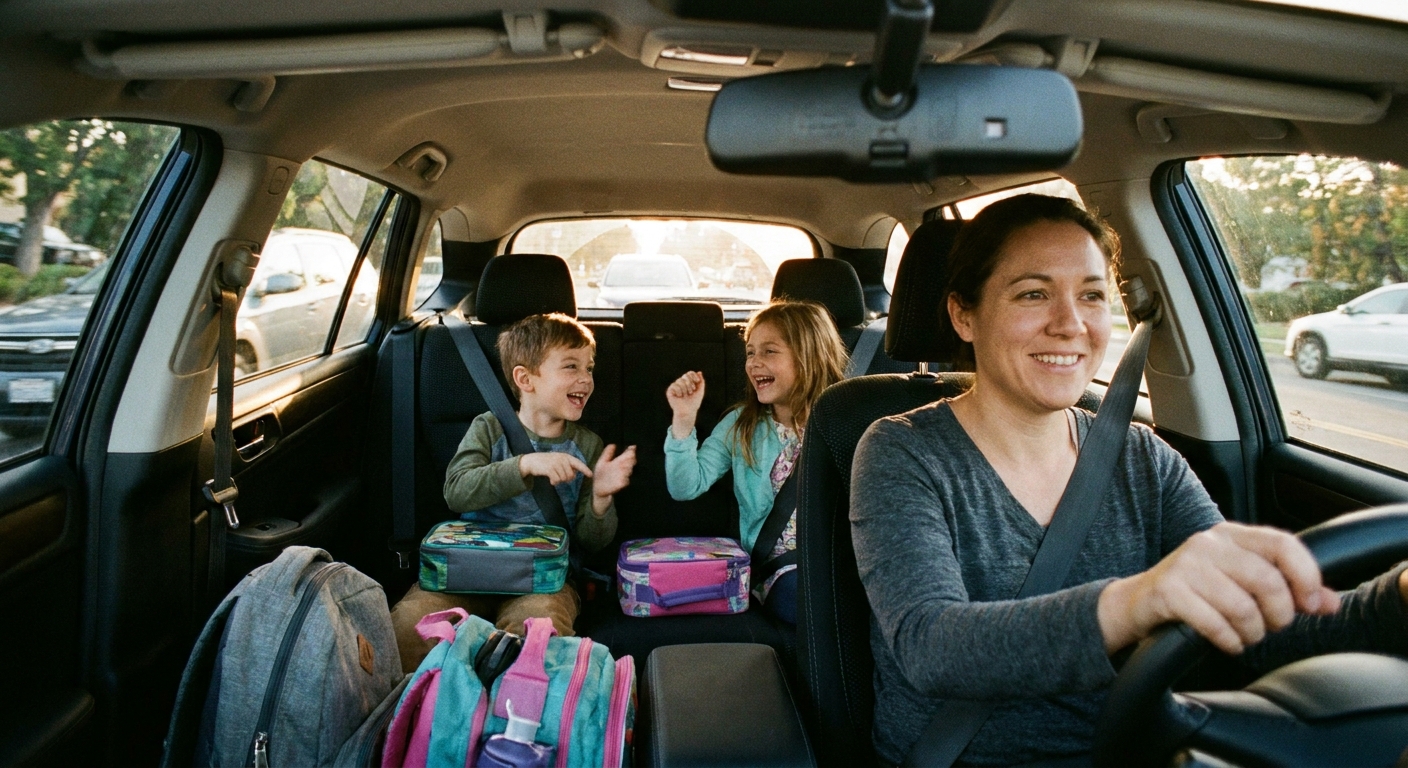
Our school commute is not long, but it is long enough for someone to lose a shoe, someone else to remember a library book, and my rescue dog to whine like we are abandoning him forever. On the mornings when I can feel the stress creeping up, I lean hard on one thing that works for us almost every time: a simple, interactive story game.
These are my favorite screen-free storytelling games for the car, bus stop walk, or even the drop-off line. They keep kids busy, encourage teamwork, and buy me a little peace so I can focus on driving.
Quick safety note: in our car, the driver does not referee debates or do complicated turns. We keep voices low, keep turns short, keep seatbelts on, and save the big reactions for after we park.
Before you start: quick rules
Story games can go sideways fast if one kid tries to control everything. These little house rules keep things fun and fair.
- One voice at a time. Kids can say “next” to claim a turn. (A raised hand works too, but words are clearer in a moving car.)
- No dead ends. If you introduce a problem, you also suggest one possible next step.
- Use a timer if needed. In the car, I count to 10 for each turn in my head. Short turns keep everyone engaged.
- Opt-out is allowed. Quiet kids can pass, or be the sound effects person instead.
If your family likes hands-on story starters, you might also enjoy our at-home version: Make a Story Path With Paper Cards. We have done it at the kitchen table on Sunday nights and reused the same ideas all week in the car.
1) “Yes, and…” story chain
This is the easiest possible setup: each person adds one sentence, starting with “Yes, and…” It keeps the story moving forward and teaches kids to build on each other instead of correcting each other.
How to play
- Parent starts: “Once upon a time, we found a mysterious backpack at the bus stop.”
- Next player adds: “Yes, and inside it was a tiny map with glitter on it.”
- Keep going around the car until you arrive.
Make it commute-proof
- Use a shared destination. “They have to get to school before the bell” quickly creates a plot clock.
- Ban ‘it was all a dream’ endings. In our car, it is the top plot escape hatch.
- Give one bonus point (imaginary points are fine) for including something you pass on the drive.
2) The two-choice adventure
If your kids argue about where the story should go, this game channels that energy into two clear options. Think of it like a choose-your-own-adventure, but spoken out loud.
How to play
- One person is the narrator for one minute.
- At the end of the minute, the narrator offers two choices: “Do we open the locker that is rattling, or do we run to the cafeteria?”
- Everyone votes quickly. Majority wins.
- Next person becomes narrator and continues from the chosen option.
Make it smoother
- Tie-breaker: do a quick coin flip, or alternate who breaks ties by day (Monday: oldest, Tuesday: youngest). I try to keep the driver out of it entirely.
- Keep choices equally good. Avoid “fun option vs. boring option,” or you will spark a debate.
3) Sound effects studio
This is my go-to on sleepy mornings or with kids who struggle to jump into story ideas. They do not have to invent the plot. They just supply the soundtrack.
How to play
- One person tells a story (even a simple one) about getting to school.
- Everyone else adds sound effects only: whooshing wind, creaky doors, robot beeps, dramatic dun-dun-dun.
- Switch storytellers every 2 to 3 minutes.
Helpful boundaries
- Volume rule: sound effects stay at inside voice level so the driver can concentrate.
- No continuous noise. Effects happen in quick bursts, not as an endless siren.
- Hands stay calm. We keep sound effects “seatbelt friendly” with no big gestures that spill into someone else’s space.
4) The alphabet plot
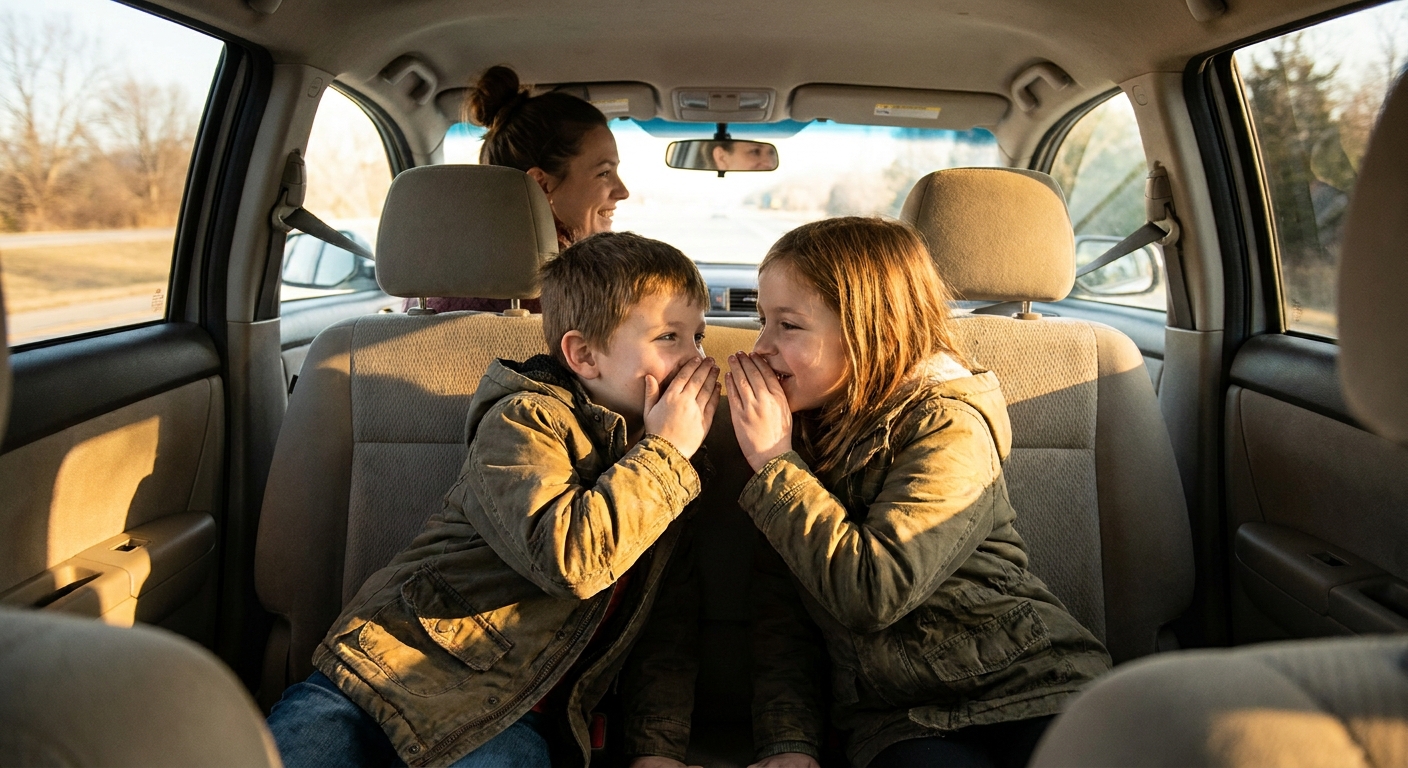
This one feels like a game and a brain warm-up at the same time. It also naturally limits how long the story can run.
How to play
- Start a story where each new sentence must begin with the next letter of the alphabet.
- Example: “Avery found a strange key. Behind the school, a door appeared…”
- For younger kids, you can do A through J only, or work as a team to think of the next letter.
Easy variations
- Theme it: “Alphabet Mystery” or “Alphabet Space Mission.”
- Word instead of sentence: each person contributes one word starting with the next letter.
5) Mystery bag, no bag
You do not need an actual bag. This is just a pretend “pull an object” game that instantly sparks story ideas. It is also great for siblings with different ages, because everyone can picture an object.
How to play
- One person says, “I am reaching into the mystery bag and I pull out…” then names an object.
- Next person must explain why that object matters in the story.
- Third person adds a complication.
- Fourth person solves it (or tries).
- Repeat with a new object.
Object ideas that work well on school mornings
- A hall pass that glows
- A lunchbox with a secret button
- A tiny trophy with someone’s name scratched off
- A pencil that writes messages by itself
6) The 60-second character interview
This game is perfect for kids who love to talk, and it can be a nice way to practice taking turns speaking and listening. It also gives some kids a chance to “try on” a confident character for a minute, which can feel steadier on jittery mornings.
How to play
- Pick a character together: “a new kid,” “the principal’s parrot,” “a time-traveling substitute teacher.”
- One child becomes that character.
- Everyone else asks interview questions for 60 seconds.
- Switch characters and repeat.
Question prompts (if your kids freeze)
- What are you carrying and why?
- What is your biggest problem today?
- What do you want from us?
- What rule do you always break?
7) Fix the ending
Some mornings, energy is a little too high, or someone is already upset. This game keeps the creativity but adds a gentle structure that can settle everyone down.
How to play
- You retell a familiar story or movie in 3 to 5 sentences.
- Then you say: “Okay, now we fix the ending.”
- Each person gets to change one thing to make a better ending, a funnier ending, or a kinder ending.
Why it works on hectic mornings
- Low pressure: kids are editing, not inventing from scratch.
- It encourages problem-solving: they practice “what could we do next” thinking.
- It tends to get silly in a good way, which can reset the mood fast.
Keep it going all week
I’m all for magical, imaginative parenting moments, but I also have to get everyone out the door. These tricks help the kids carry most of the creative load.
- Assign a daily starter. Monday: oldest starts. Tuesday: middle. Wednesday: youngest. Rotate.
- Use landmarks as prompts. “At the red light, a new character appears.” “At the bridge, something goes wrong.”
- End with a cliffhanger. If you stop mid-story, they will beg to continue tomorrow.
- Keep a running cast. Reuse favorite characters across games, like a shared family story universe.
Drop-off trick: before the door opens, we “bookmark” the story in one sentence. “Okay, tomorrow we find out what is inside the locker.” It makes the ending feel neat, even if the ride was chaotic.
Quick FAQ
What if my kids fight over the story?
Switch to a game with built-in turns and limits, like The Two-Choice Adventure or Alphabet Plot. Also try “one sentence only” turns for a few minutes to reset fairness.
What ages do these work for?
Most work for ages 4 to 12 with small tweaks. Preschoolers do best with Sound Effects Studio and Mystery Bag, No Bag. Older kids usually love Two-Choice Adventure and Fix the Ending.
We ride the bus. Can these still work?
Yes. Keep voices low and choose games that do not require everyone to talk at once. Character Interview can be done with two kids, and Yes, and… works quietly in short sentences.
What if I cannot participate much because I am driving?
Totally normal. Pick one child as the game leader and let them handle turns. Your job can be one quick prompt at the start: “Today’s story has to include a lost pet and a surprising helper.”
What if I only have one kid in the car?
Two easy options: (1) play Two-Choice Adventure with you offering the two choices and your child voting, or (2) do Character Interview where your child is the character and you ask the questions. If you are driving, keep it simple and let your child do most of the talking.
For more low-prep story ideas and family-friendly routines, you can browse our kids content here: Kids Stories.